The biggest outsourcing decision of my life went the wrong way, if you only read the spreadsheet.
When my first child was born, I ran the numbers on going back to work. Childcare for the early years was going to run about $50,000 a year — after tax, which meant I’d have to earn well over $70,000 just to break even on someone else raising my kid from 8 to 6. The spreadsheet still said go back. Salaries compound. Careers stall when you step out. Every financial planner on earth would have told me to pay for the childcare.
I didn’t. And running that math — really running it, instead of doing what the default path said — is what eventually unraveled the whole thing: the 17-year job, the city, the life script. We ended up in Portugal. That’s a longer story.
I’m telling you this up front because today’s post is going to argue you should pay other people to do more things for you, and I want you to know I don’t hold that position cheaply. The point was never “outsource everything.” The point is to actually run the math — because most people never do, in either direction.
The question I stole from real estate
I spent years in private-equity multifamily real estate. Before any acquisition, you ask one question about the property: what is its highest and best use? Not “what is it currently doing” — what could it produce, and is anything standing in the way?
Nobody asks this about their own hours.
Here’s the strange part. When your employer promotes you or raises your pay, they’re publicly declaring that your time became more valuable. And then most people go home and keep spending that newly-expensive time exactly the way they did when it was cheap — cleaning, errands, lawn care, the same Saturday they’ve run for a decade. It still feels responsible. Frugal. What they’ve stopped asking is what the responsible choice actually costs now.
Run your real number
First, get your actual hourly rate. Not your salary divided by 2,080 — that flatters you. Take what lands in your account each month and divide it by the hours the job really takes: the commute, the Sunday-night email, the recovery time. That’s your number. For most people it’s lower than they’d guess, and it still makes half their to-do list indefensible.
If your hour is worth $40 and a cleaner charges $20, you’re not saving $20 by doing it yourself. You’re paying $20 for the privilege. Grocery delivery runs $5–10 depending on the service; the round trip to the store eats most of an hour and you come home with things you never meant to buy. I know this math cold, and I still skip the delivery some weeks, because pushing the cart myself feels like virtue. That’s the part nobody tells you: the flip isn’t a switch you throw once. It’s an argument you keep having with an earlier version of yourself, and she’s a formidable opponent.
The first thing we handed off after the move was the cleaning. In Portugal, our cleaner costs $8 an hour. Eight. The math wasn’t a close call — it wasn’t even a calculation, really, just a confession that the only thing stopping me had been the idea of myself as someone who cleans her own house. Those hours go to the kids and the writing now, and I have never once stood in a clean kitchen wishing I’d done it myself.
One condition, and it’s the whole game: the trade only pays if the reclaimed hour goes somewhere. Time with your kids, deep work, learning, real rest — fine. Reclaiming an hour from the supermarket to spend it scrolling is just paying for a different waste.
The things you should never outsource
Now the part the optimization crowd gets wrong.
I drive my kids to school. There are services for that; the math says delegate it. But those twenty minutes — the half-finished thoughts, the weird questions, the last check-in before they walk into their day — are not a task. Hiring that out wouldn’t free my time, it would amputate it.
Gardening fails every hourly-rate test ever devised. Home-grown tomatoes are the most expensive tomatoes you will ever eat. Grow them anyway, if it’s the thing that puts you back together. Time spent on what genuinely sustains you isn’t spent. It’s invested. The highest-and-best-use question applies to everything except the things you do because they’re yours.
The skill is telling the two apart honestly. “I fold the laundry because it’s meditative” is sometimes true and sometimes a story frugality tells to keep its job.
This week: the audit
Don’t think about this in the abstract — you’ll nod along and change nothing. Do this instead, it takes half an hour:
- List every recurring task you did last week that someone else could do. Cleaning, errands, returns, admin, yard, repairs.
- Next to each, write what it would cost to hand off, and the hours it took you.
- Sort into three piles: hand off now (costs less than your hour is worth), keep — it’s mine (the school runs and gardens), and the squirm pile — things you’re keeping but can’t say why.
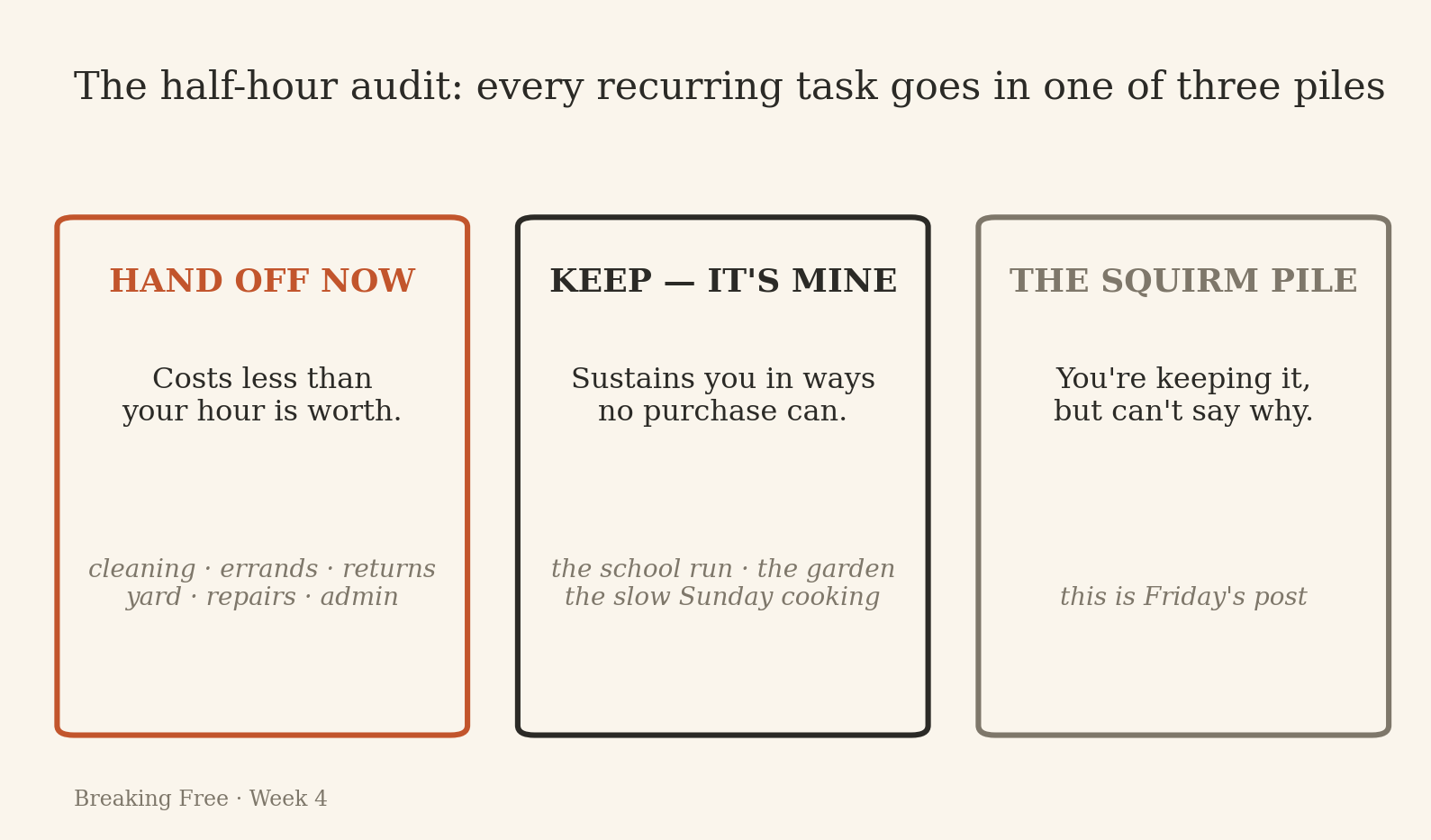
Print it, stick it on the fridge, argue with it.
The third pile is the interesting one. That’s Friday’s post.
Full disclosure: I redo this audit every few months, and my squirm pile has never once been empty. It just rotates its membership. [PLACEHOLDER: one thing currently in your squirm pile — naming yours buys the reader permission to name theirs]
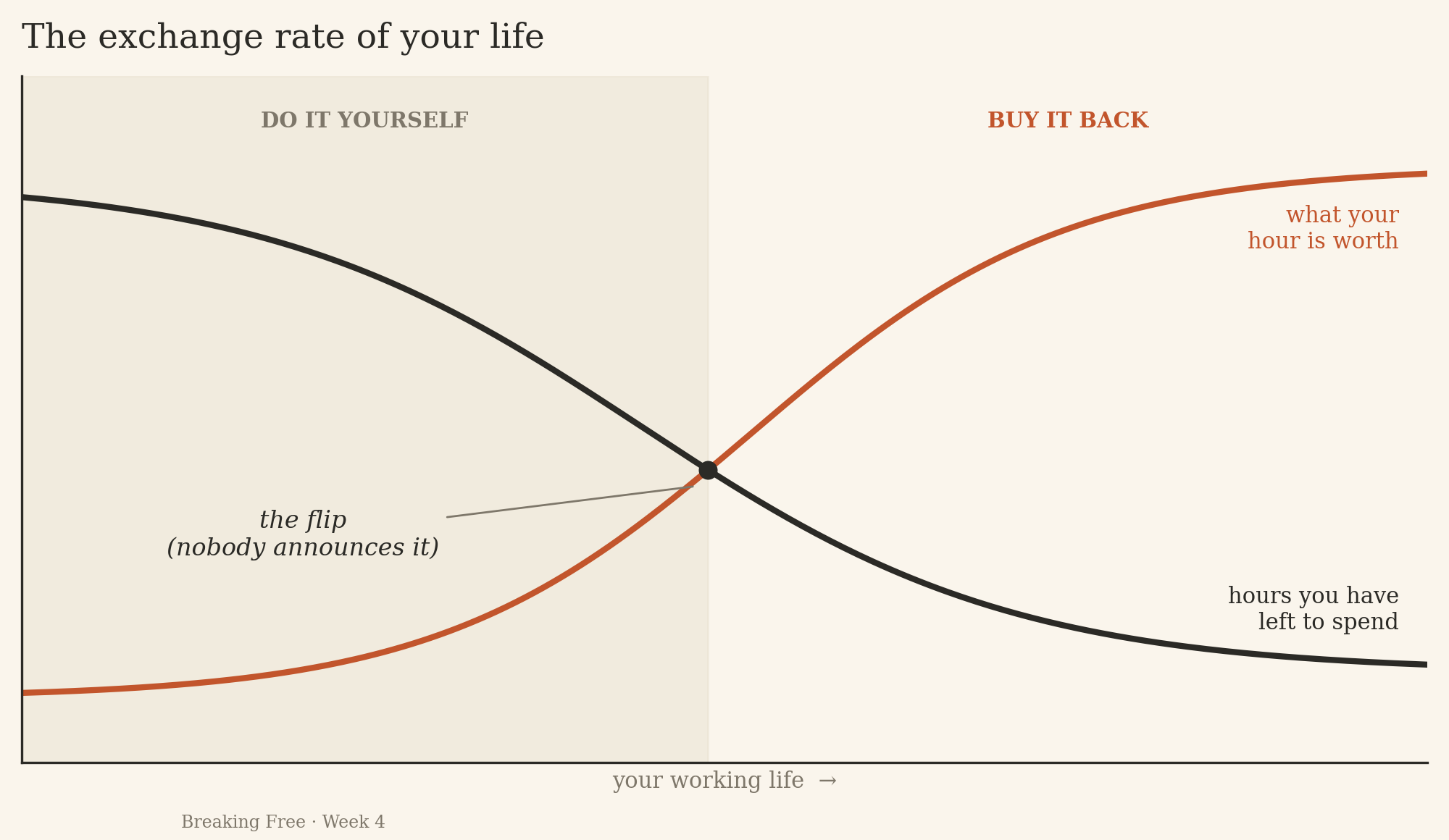
The flip: nobody announces it. You have to notice it yourself.
Where you are on the curve matters: if you’re early, time-rich and cash-poor, aggressive DIY is still right — keep it. But if the base is built and the snowball is rolling, and you’re still living like it’s year one, nobody is going to tap you on the shoulder and tell you the math flipped.
Consider this the tap.
Friday goes after the squirm pile: what happens when frugality stops being a tool and becomes who you are. If this landed, subscribe — the Tuesday post gives you the mechanics, the Friday post tells you what they’re for.
Reply and tell me: What ended up in your squirm pile — the task you’re keeping but can’t defend?
— Ashleigh